
Release date:2026-01-15 Browse:
Chemical Cross-linking Mass Spectrometry (XL-MS) is a pivotal technique for investigating protein-protein interactions (PPIs). It employs cross-linkers to chemically conjugate interacting proteins or protein complexes within a defined spatial proximity. Subsequent mass spectrometric analysis of the cross-linked peptides enables the mapping of protein interaction networks and the identification of specific interaction sites. XL-MS can also be integrated with other techniques, such as cryo-electron microscopy (cryo-EM) and X-ray crystallography, for structural biology studies.
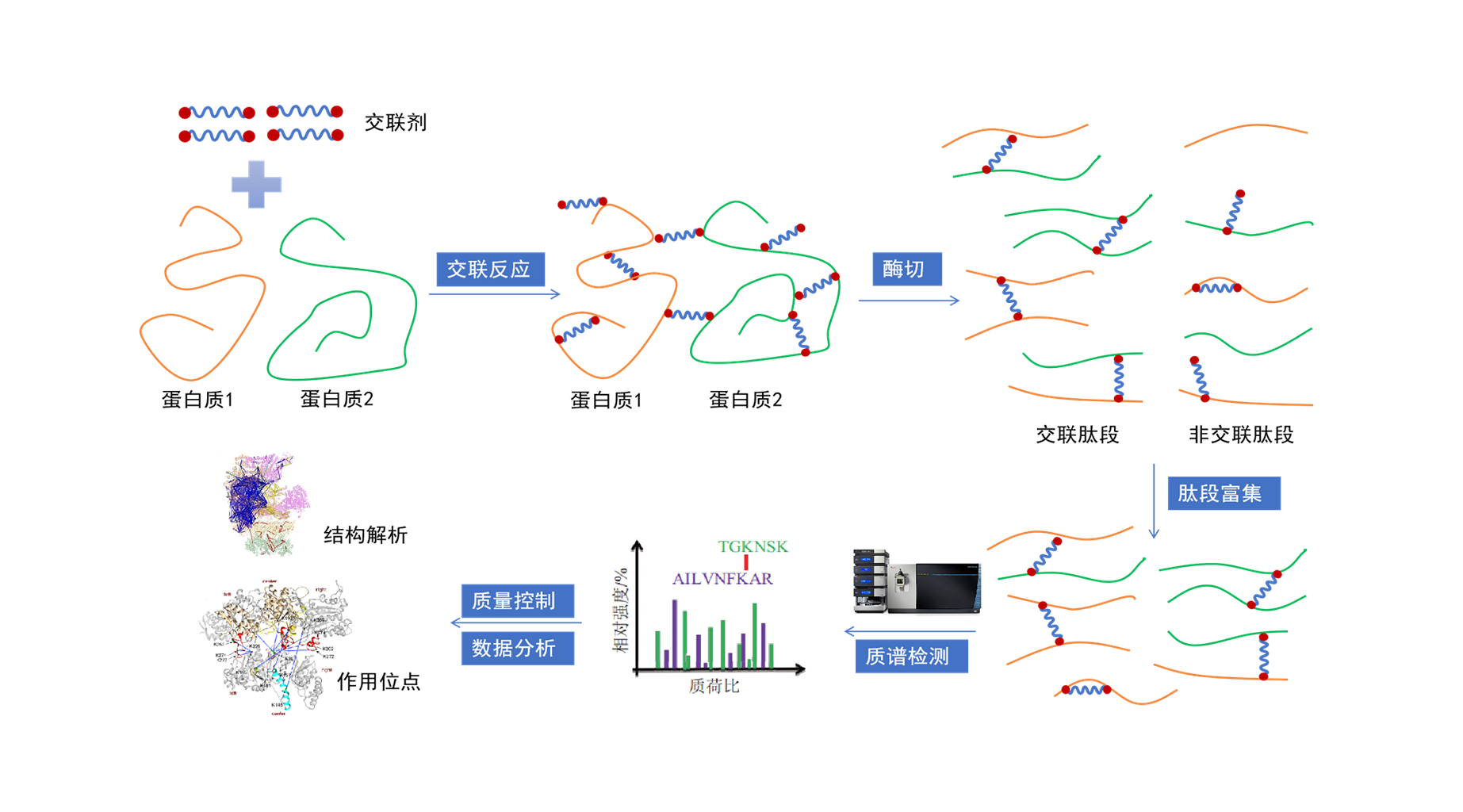
Service Advantages
• High Throughput & Rapid Analysis: Enables efficient processing of multiple samples.
• In-cell Cross-linking Capability: Allows for the analysis of interactions within their native cellular environment.
• No Special Chemical Labeling Required: Simplifies sample preparation by eliminating the need for protein tags or labels.
• Captures Transient/Weak Interactions: Cross-linkers covalently link two or more interacting proteins, preserving even short-lived or weak complexes for detection.
Application
• Protein Structure Elucidation
• Study of Interaction Dynamics in Protein-Protein Complexes
• Mapping of Protein-Protein Interaction Interfaces and Sites
Service Workflow
Clients may send pre-crosslinked samples or consult with us to develop a cross-linking strategy before sample submission. We will then perform the complete workflow, including enzymatic digestion, peptide enrichment, mass spectrometry detection, and data analysis, concluding with the delivery of a comprehensive experimental report.



 粤公网安备44030002008509号